
Jump to section:
- What is Emotional Intelligence?
- What are the main elements and different parts of emotional intelligence?
- Models of Emotional Intelligence
- Mixed model of E.I.
- Why is Emotional Intelligence important?
- How can Emotional Intelligence be improved and how can Emotional Intelligence be developed?
- Does Emotional Intelligence relate to job performance?
- Does Emotional Intelligence relate to an individual’s well-being?
- Why is Emotional Intelligence important for leadership?
- Use the EIP3 assessment to foster your potential leaders’ emotional intelligence
- How to be a more emotionally intelligent leader?
- The impact of Emotional Intelligence in the workplace

What is Emotional Intelligence?
Emotional Intelligence (EI) is about the ‘intelligent use of our emotions’ or ‘thinking about our feelings to guide our behavior’. This applies to both ourselves and our relationships. For example, an individual who is feeling anxious about a presentation could practice a breathing exercise to promote relaxation. Or a presenter who notices that others are looking bored during a presentation could respond by increasing the engagement level with the audience.
Being aware of our feelings and the feelings of others is essential because it helps us to manage ourselves and our relationships more effectively. Consider the analogy of driving a car: A driver learns how to optimize a vehicle’s performance by:
- Keeping it well maintained (our health and well-being)
- Listening to the engine (our body and feelings)
- Handling it skillfully (our habits and behavior)
- Navigating the traffic and roads (our awareness of others and managing interactions with them)
In essence, Emotional Intelligence is about becoming skillful and effective at managing ourselves and our relationships.
What are the main elements and different parts of emotional intelligence?
Over the last 25 years, research into EI has taken two distinct and contrary pathways (Figure 1). One examines EI as an ability, measured as maximum performance; the other describes EI as a mixed array of emotion-related traits or competencies, measured as typical performance. Typical performance concerns how we tend to behave most of the time and is usually measured using subjective self-report questionnaires. In contrast, maximum performance relates to how we perform when exerting maximum effort and is usually measured using objective, ability-focused questionnaires. This fundamental difference in how EI is measured may explain why only a weak correlation exists between ability and mixed/trait measures of EI.
Models of Emotional Intelligence
The earliest abilities model of EI was put forward by Peter Salovey and Jack Mayer who proposed four EI abilities:
Perceiving emotions
Using emotions
Understanding emotions
Managing emotions
Typical performance models of EI may broadly be separated into three groups:
Competency-based measures which include emotional and social competencies that contribute to effective performance at work
Trait-based measures that encompass the emotional aspects of established personality models
Mixed measures which include a wider range of skills and attributes that may overlap with both the competency and trait-based models of EI.

Mixed model of E.I.
One of the earliest mixed models of EI was put forward by Daniel Goleman that comprised of four elements to EI:
Self-awareness
Self-management
Social awareness
Relationship management
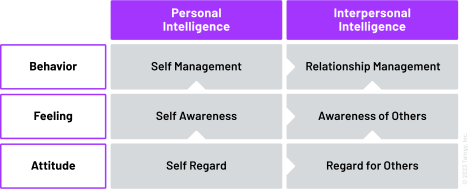
An extension on this approach to EI is an attitude-based model that provides an organizational framework for the different elements of EI.
Why is Emotional Intelligence important?
Emotional Intelligence has influenced society, politics, corporate, and educational life. The concept has been at the forefront of a fundamental shift in the western world, where psychological well-being, resilience, adaptability, neurodiversity, mental-health, mindfulness, and other concepts related to workplace emotional intelligence have become mainstream considerations. Over the last two decades, we have seen an exponential growth in interest around EI, specifically emotional intelligence in the workplace, driven by an ever-increasing demand from organizations.
There are many reasons why it is important to develop emotional intelligence at work. Evidence shows that workplace emotional intelligence is an important factor in determining our job performance, as well as the following:
- EI can help improve our well-being
- EI helps build our emotional resilience so that we can recover more quickly from disappointment
- EI can help increase our levels of motivation and engagement
- EI can improve our relationships
- EI also positively impacts leadership, as leaders with high workplace emotional intelligence are often more effective leaders
How can Emotional Intelligence be improved and how can Emotional Intelligence be developed?
In order to develop emotional intelligence, it’s important to understand how people process emotions, and also the science behind EI.
Early models in psychology described human behavior in terms of stimulus and response. That is, something happens, and a person responds to it. However, later psychology and neuroscience has shown us that there are several parts that fall between these two steps, including thoughts, feelings, and attitudes.
Consider the following example:
- Stimulus: Imagine the situation of a colleague criticizing a person’s work.
- Attitude: This may trigger an underlying attitude a person has about themselves, e.g., I am not good enough.
- Feeling: Which may cause the person to feel upset or angry.
- Thinking: This in turn may provoke the person to think: I give up, why should I bother making an effort if people are just going to criticize me?
- Behavior: The person may then respond by withdrawing or sulking.
- Outcome: Which will likely result in a negative outcome, such as deterioration of the professional relationship.
Understanding these different stages of emotional processing is important because it helps explain how people can learn to manage their thoughts, feelings, and behavior to be more emotionally intelligent.
- Stimulus: rather than associating with people who bring you down, you could seek out people or situations that bring out the best in you.
- Attitude: rather than being critical of yourself, you could actively look for instances where you have been capable and effective in what you have done.
- Feeling: A commonly used technique to change emotional state and calm down is to practice relaxation techniques such as taking slow, deep breaths.
- Thinking: There are many practical ways to reduce negative thinking, such as through mindfulness training, physical activity, and positive thinking.
- Behavior: In the example, instead of withdrawing from a conflict, a person could practice and rehearse being more assertive in these situations.
- Outcome: A powerful way to make change happen is through visualizing a different outcome and setting positive expectations.
Does Emotional Intelligence relate to job performance?
One of the most common questions from organizations that are considering using EI: Does EI predict performance, and if so, will it improve on our existing assessment tools and processes? This question has been widely addressed over the years with published studies demonstrating the predictive value of EI to job performance within many international organizations, including Amazon, BMW, Google, HSBC, Microsoft, Qatar Airways, Shell, and Whitbread PLC, to name a few.
More substantive evidence comes from multiple meta-analyses, which combine data from several published individual studies. These meta-analyses show that mixed/trait EI is predictive of job performance criteria and helps to increase our prediction of future job performance when combined with measures of personality and cognitive ability.
One study described the correlations with performance as, ”large enough to generate significant savings and improvements for organizations that use measures of EI.” Another concluded that practitioners may choose to use mixed EI as, “a practical, shorthand alternative to a lengthy battery of several more traditional KSAOs (knowledge, skills, ability, and other personality instruments).”
Overall, research studies provide sound evidence that EI predicts job performance across a variety of roles. In particular, EI appears to be very relevant to roles which incur high emotional labor (e.g., customer service, sales, and management).

Does Emotional Intelligence relate to an individual’s well-being?
The case for improving employee well-being is not just morally imperative but financially compelling. The cost of poor mental health across the globe is staggering and is a primary cause of long-term absence. A report by Gallup found that four out of five adults feel stressed throughout the day, with work being a major cause.
While supporting the well-being of employees may seem like an additional expense, the return on investment is high. In 2017, a study of almost 50,000 business units in 45 countries discovered that workgroups who received strengths interventions saw sales increase by 10% (to 19%) and profits by 14% (to 29%).
Developing EI has proven to be a valuable method for building resilience, reducing stress, and enhancing well-being. Research indicates that greater EI facilitates more positive emotional states and fewer negative moods, thereby achieving a greater sense of well-being.
A comprehensive meta-analysis with more than 19,000 participants found a strong relationship between high EI and mental health, psychosomatic health, and to a lesser extent physical health.
Why is Emotional Intelligence important for leadership?
Leadership has been described as an emotionally laden process, and leaders’ emotions and behaviors have been found to profoundly influence followers’ emotional reactions. There is an abundance of organizational literature proclaiming the importance of emotional intelligence in leadership. One meta-analytic study on 1,407 leaders found that EI adds significant value over and above leaders’ cognitive ability and broad personality traits in predicting subordinate job satisfaction. They recommend “including EI in leadership education, training, and development… [and when making]… personnel decisions.” Another review of the academic literature concluded that “emotional intelligence is an important driver of effective job performance and successful leadership.
It is widely recognized that today’s leaders are operating in a fast-paced, challenging and often unpredictable work environment. These conditions create greater stress and demand on individuals to be more adaptable, creative, and emotionally resilient; all features that reflect the importance of emotional intelligence for leadership.

Use the EIP3 assessment to foster your potential leaders’ emotional intelligence
Learn how to foster emotional intelligence in the workplace, so leaders can develop stronger relationships and increase their effectiveness. Use the EIP3 assessment to measure the emotional intelligence of leaders to make hiring and promotion decisions easier.
How to be a more emotionally intelligent leader?
The following model provides a useful framework for considering the different components of emotionally intelligent leadership and tips for self-development.

Self regard
This is the cornerstone to all aspects of EI. Greater self-belief will help leaders be authentic, self-directed, and principled.
Tip: Show yourself compassion. If you notice yourself being self-critical, counter this with two positive affirmations
Regard for others
Self regard needs to be balanced with regard for others to avoid self-serving narcissistic tendencies. An effective leader will value and get the best out of others.
Tip: Look for opportunities to show others you appreciate them. Notice what they do well and how they help others.
Self awareness
Knowing oneself is necessary in order for leaders to accurately calibrate and not to over-estimate their capacity to deliver.
Tip: Ask a colleague for feedback on something specific you would like to develop.
Awareness of others
Leaders should also have humility and awareness of others, enabling them to select the right advisers to balance and support them in areas where they are less strong.
Tip: Dedicate 10 minutes every day to listen to one colleague. Ask question and don’t interrupt!
Relationship management
Building trusting and collaborative relationships will enable leaders to influence, inspire, and motivate others.
Tip: Risk being more open. Let yourself be known by your colleagues, and express your feelings, concerns, and wishes.

The impact of Emotional Intelligence in the workplace
The world of work is changing.
Less than one-fifth of managers (17%) report that their organization has the leadership and people skills to take advantage of AI (Artificial Intelligence); nearly one in three managers (31%) do not believe that their leaders and managers are able to engage and facilitate collaboration across generations; and almost half (49%) do not believe that the management in their organization has the skills needed to effectively manage virtual teams.
Download this whitepaper to discover:
- Can EI be developed?
- The business need for EI
- Understanding and measuring EI
- Does EI predict job performance?
- Does EI support engagement at work
- Can EI enhance well-being?
- Is EI important for leadership?
- What is the added value of EI?