

What is an early career professional?
An early career professional is someone just starting out in their career, typically with less than five years of experience in a white-collar role. Often called ‘graduates’ or ‘entry-level talent’, these professionals are eager to grow, learn, and build their expertise. Because early career professionals may have limited experience but significant growth potential, employers should focus on assessing potential rather than experience alone when hiring for these roles. A well-defined early career hiring strategy is essential for organizations, helping them effectively attract and identify the next generation of their workforce and its future leaders.
What is an early career talent assessment?
An assessment that is specific to early career talent enables employers to understand a candidate’s current skills, as well as the behaviors, aptitudes, and attitudes that will help them grow into more senior roles in the future. This information is especially important for early careers because so little performance history exists to draw on. As early career talent is often at a stage of life where they want to select the right employer just as much as the employer is selecting them, an early career talent assessment also needs to be engaging to complete, informative about the organisation, and provide meaningful self-insights to support an individual’s further development.
Talogy Spotlight: An early career talent assessment solution
Strengthen your organization’s potential and prepare for a successful, forward-thinking future. Talogy Spotlight is built for modern entry level hiring, supported by up-to-date global research. Our early career talent assessment solution helps you measure exactly what you need and provides you with the necessary insights to select the right people for your organization, for now and the future.
What does Talogy Spotlight assess?
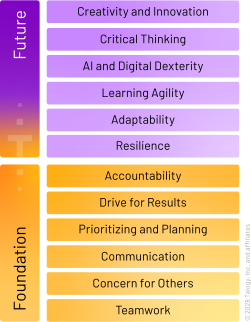
Based on the latest early career research insights, Talogy Spotlight measures 12 essential skills for insight into early careers success today and growth potential in the future. By providing a comprehensive evaluation across these core areas, our early careers talent assessments are likely to predict success across a broad range of professional roles.
Our model enables organizations to make informed decisions about their early career hires for both the short and long term. It assesses the skills needed for early career professionals to succeed now, while also considering what might be needed in the future. The Spotlight model is grouped into two categories:
- Foundational skills: Spotlight measures 6 essential skills early career talent should possess to perform effectively in their role today, such as accountability, prioritizing and planning, and communication.
- Future-focused skills: 6 research-backed skills that support early career professionals in their growth towards more senior roles, such as AI and digital dexterity, adaptability, and resilience. Early career professionals that master these skills show strong growth potential for the future
The Spotlight graduate assessment solution is a great tool in conjunction with the rest of the recruitment process to paint a full picture of the graduates. The reports are comprehensive and allowed us to really dig into individual strengths and areas where candidates scored lower at the interview stage. The graduates we hired scored really highly on the assessments, and so far they are performing really well!

An approach based on the latest early career research
The needs of the next generation have shifted considerably over the past few years and are expected to continue evolving at a rapid pace. Talogy conducted global research to identify the preferences of the market by looking at early career professionals, job seekers, and hiring managers – and sought to understand what hiring managers and candidates are really looking for. The insights from this research helped to shape our approach to early career talent management and assessments, highlighting talent challenges within the market such as:
- Early career success criteria: Defining the key skills required to succeed in early career roles.
- Early career attraction: Attracting early talent in an increasingly competitive environment.
- Early career talent assessment: Assessing early talent in a relevant and engaging manner.

Rely on data-driven insights to build your next-generation workforce and drive your organization forward.
Build an effective early career talent strategy with Talogy
Hiring the best early career talent is just the beginning. A complete early career talent strategy covers onboarding, development and potential identification – and ultimately, internal mobility into more senior roles. Talogy Spotlight offers solutions to support your early career talent management approach from start to finish, with reports for identifying high–potential talent, cohort analytics, and development tools that ensure your early career talent masters the essential skills, behaviors, and attitudes to help them grow into their future roles. With 75+ years of experience, 30milion+ assessments yearly, and 150+ Organizational Psychologists around the world, Talogy is the preferred partner to help you create an early career talent strategy that’s built to last.

Ethical AI for smarter, fairer talent assessment solutions
At Talogy, we make sure AI is used fairly and ethically in our assessments. Our experts use it to fuel talent solutions where it matters, and we implement a range of measures to mitigate misuse. From honesty contracts and score monitoring, to technology features designed to block copy and paste actions. Our different assessment formats are crafted to create robust measurement, and ensure fairness and accuracy.
Explore the latest early career thinking
Stay ahead with insights, research, and best practice for hiring and developing early career talent.
Starting a career in the age of AI: The human skills that matter
How to hire the best employees for entry-level positions
How to design an early careers experience aligned with employee values
Why uncovering high-potential early talent is a sustainable advantage
Big picture thinking
We can help you solve your talent challenges through our unique blend of psychology, technology, and expertise. Talk to us today about how we can partner with you to build brilliant talent solutions.
Ready to transform your early career talent strategy?
Early careers FAQs
Early career talent management is the process of attracting, assessing, developing, and retaining professionals at the beginning of their careers. Unlike broader talent management practices, it focuses on individuals with limited work experience but strong potential for future growth. Effective early career talent management helps organizations identify transferable skills, support development opportunities, and build a pipeline of future specialists and leaders.
Early career talent typically includes professionals with less than five years of work experience. This group may include graduates, interns, apprentices, and individuals in their first professional roles, usually without line management responsibilities. Whereas, mid-career professionals typically have between five and fifteen years of experience, greater role expertise, and may have leadership or people management responsibilities.
Organizations should focus on assessing transferable skills that predict long-term success and growth potential. Talogy’s 2024 global research identified four skills that are particularly important for early careers: AI and Digital Dexterity, Critical Thinking, Accountability, and Learning Agility. These skills help individuals adapt, learn quickly, and succeed in rapidly changing work environments.
Yes. While Talogy Spotlight measures the core skills that predict success across early career talent populations, the assessment itself can be tailored to specific roles, functions, and organizational needs. Additional modules can also be included to identify the roles that best align with a candidate’s preferences, motivations, and values.
Talogy Spotlight assesses early career talent through a combination of personality, cognitive ability, and situational judgement measures. Our assessment evaluates 12 essential skills that help graduates and other early career professionals succeed in today’s workplace and grow into future roles. Talogy Spotlight is grounded in global early career talent research and can be tailored to organizational requirements.
Talogy Spotlight helps organizations efficiently assess large volumes of early career talent through an automated, scalable assessment experience. The solution integrates with applicant tracking systems (ATS), streamlines candidate screening, and provides dynamic dashboards that support faster and more informed hiring decisions.
Talogy Spotlight is designed to create an engaging early career talent assessment experience. The assessment is dynamic, mobile-friendly, and quick to complete, with gamified elements that help maintain candidate engagement. Organizations can personalize the experience using custom videos, branded content, and values-based exercises, while candidate feedback reports provide valuable development insights regardless of hiring outcome.
Organizations can improve their early careers assessment experience by making assessments informative, relevant, and engaging. Sharing information about the organization, helping candidates understand their fit for a role, and providing a streamlined assessment experience all contribute to stronger engagement. Offering personalized feedback and development insights also helps candidates feel valued and supported throughout the hiring process.
Assessing early career talent requires a greater focus on potential rather than past experience. Because graduates and other early career professionals may have limited work history, organizations often assess transferable skills, cognitive ability, personality, and learning potential to predict future success. This approach helps identify candidates who can grow and thrive over the long term.