
Skills-based hiring
Skills have quickly become a prominent component in organisational hiring strategies, with 80% of companies shifting to a skills-based hiring model.
Should you be adopting skills-based hiring practices in your organisation? Find your answers to this and more, including finding the balance between skills and competencies, below.


What is a skills based hiring approach?
Skills-based hiring is an approach to talent acquisition that evaluates candidates based on their skills rather than their education or previous job experience. Hiring strategies based on past achievements are losing relevance because technology and job roles are evolving rapidly. Therefore, a skills-based hiring approach allows organisations to broaden their talent pool and align the best-fit candidates to the right roles more flexibly.
What are skills?
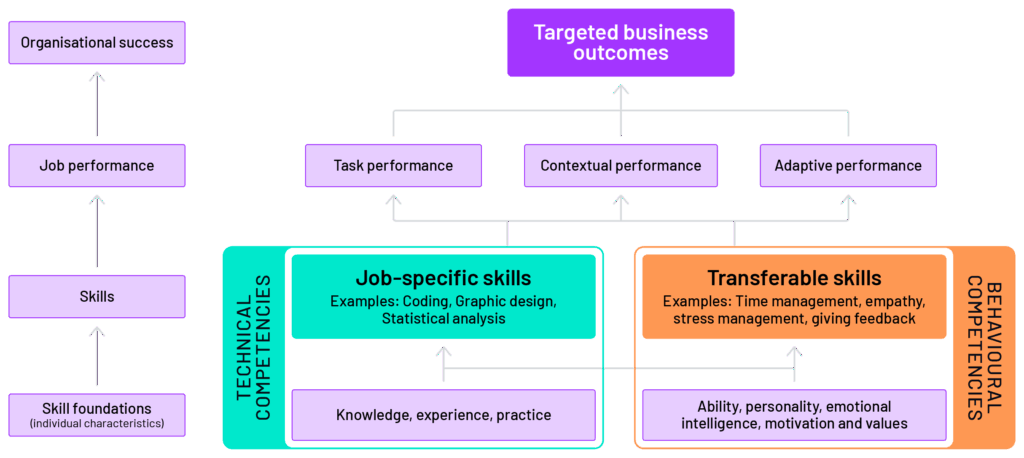
At Talogy, we define skills as learned, applied abilities required to complete a task. Those abilities may include both job-specific skills and transferable skills.
Job-specific skills (also called ‘hard skills’) are specialised areas of technical expertise and knowledge needed to perform functional tasks effectively, like coding, graphic design, or accounting. They are typically learned through specific training and on-the-job practice.
Transferable skills (also called ‘soft skills’) are skills that are important for successful performance across many different roles. They often relate to personal productivity and working effectively with others. Examples include time management, showing empathy, or networking. They are influenced by an individual’s personality, ability, motivation, and values, and are often developed through work and life experience rather than specific training.
Discover the brightest early career professionals and shape your future workforce
The next generation’s needs have shifted and are expected to continue evolving rapidly. Approaches to hiring are evolving rapidly too, with skills – both technical and transferable –taking priority over education and experience in the selection process.
Talogy Spotlight™ is a new early careers selection solution, based on global research. Start identifying candidates with the skills and competencies essential for the future of work.

How to implement skills-based hiring in 5 steps
Organisations can follow these five steps to help put their skills-based hiring plan into practice:

1. Secure leadership support
After building your plan, articulate your objectives clearly through a strong communication strategy and ensure leadership buy-in from the start.
2. Define ‘skills’ for your organisation
Identifying and aligning how your organisation defines ‘skills’ will make it easier to implement and maintain a skills-based hiring strategy.
3. Measure the right skillsets for today and beyond
A comprehensive approach should measure both job-specific and transferable skills.
4. Integrate skills into your hiring process
Embedding skills into your current hiring process doesn’t have to mean starting over. A skills-based talent strategy can be tailored to your needs and easily integrated using your existing process.
5. Make it sustainable
Skills are dynamic, so continuously evaluating, refining, and improving your hiring process is crucial to successful implementation.
What are the risks and challenges of taking a skills-based hiring approach?
With all the advice that’s available, the first challenge organisations face with skills-based hiring is overcomplication. In our experience, keeping it simple and building clarity is important. After that, challenges for adopting a skills-based talent management strategy may include:
Changing mindsets
Shifting to skills-based qualifications can be a significant change for managers.
Mitigating the risk that comes with strategy change
Any shift in hiring strategy needs to be well-designed, executed, and continuously reviewed to demonstrate ROI.
Balancing transferable skills with job-specific skills
Focusing only on technical skills without considering transferable skills will lead to failure. This is especially true for technical skills roles because those roles will be impacted the most by rapid changes in innovation. Organisations should also measure transferable skills to ensure current roles are filled and long-term growth is achieved.
Gaining internal buy-in
Demonstrating the rewards of skills-based hiring specific to business units, organisational growth, and outcomes can help gain crucial stakeholder buy-in to lead and sustain change.
Implementing quickly and at the right time
A skills-based hiring approach can take time to fully design and implement, but implementing swiftly is key to strategic relevance, impact, and outcomes – the skill sets needed for today could be out of date by tomorrow.
Measuring effectiveness
Ongoing monitoring and tracking of leading indicators (e.g., time-to-hire ratio) and lagging indicators (e.g., quality of hire) can provide valuable insights into the effectiveness of your skills-based hiring plan – but they can be challenging to implement. Identifying key performance indicators (KPIs) in the initial strategy planning can also help establish goals and drive results.

Get exclusive insights into the latest in skills-based talent management
If you’re looking for an in-depth resource to help you simplify and navigate skills-based hiring, download our new eBook: Making skills-based hiring work.
Our goal for this eBook is to provide organisational leaders with:
- Clear steps for applying this approach in your organisation
- Possible pitfalls and challenges in moving to a skill-first strategy
- Straightforward, practical guidance on how to think about skills-based hiring
What is Talogy’s skills-based hiring model?
As well as defining skills, it’s important to have a clear view of how skills fit alongside other concepts in talent management. Our Model of Skills-Powered Performance is founded on scientific principles of human characteristics and performance at work and centres on the concept of ‘skill foundations.’ This means candidates or employees have various individual characteristics which will influence how motivated and effective they might be at acquiring specific skills, like personality, emotional intelligence, and ability.
Skills-Based Hiring: Frequently Asked Questions
The lack of consistency in defining ‘what is a skill’ in our market makes this question difficult to answer. Both competencies and skills focus on behaviours that impact successful role execution, but there are three key differences between them:
1. Skills are typically more specific and task-focused compared to competencies, highlighting the practical abilities needed to perform particular work tasks. Competencies are broader and often relate to a combination of personality, attitude, ability, and approach.
2. Skills can relate to both the technical aspects (job-specific skills) and behavioural aspects (transferable skills) of a role, while competencies generally tend to concentrate only on the latter.
3. Skills can be developed through training, coaching, and deliberate practice. Competencies can also be developed, but because some competencies are often influenced by a person’s personality and values, they may require a fundamental shift in an individual’s mindset.
Role-based hiring focuses on filling specific job positions with candidates whose experience and educational qualifications match the criteria for those specific roles. In comparison, a skills based talent strategy in hiring moves away from a candidate’s experience and qualifications and instead focuses on the candidate. Skills-based hiring revolves around understanding a candidate’s abilities, competencies, and potential rather than just relying on their CV. In skills-based hiring, there may also be a focus on looking at their fit to multiple roles rather than a single specific job. This approach allows for greater flexibility and agility as organisations respond to change.
Every organisation is different so whether they should focus on skills-based hiring really depends on their processes, culture, and goals. The reason why a skills based talent strategy might be right for an organisation is that hiring decisions based largely on pedigree and experience are rapidly losing relevance in a dynamic job market. This means that focusing on who a person is – not just what they know or what they’ve achieved – is becoming a more effective approach in a world where jobs change constantly. Skills-based hiring features an agile, dynamic view of individuals which organisations find appealing because it supports future-ready strategies and internal mobility.
Adopting a skills-based hiring approach can be easier than you might first think. Competency frameworks and other structured hiring processes, which many organisations already have, are a solid foundation to build upon. Skills can build a layer of detail into your competencies, creating a more dynamic ‘fit’ profile for current requirements. Many organisations use the opportunity of implementing skills to reduce the impact of experience and qualifications on their hiring decisions. However, it’s the organisation that ultimately needs to choose which components factor into their talent decision-making process, depending on its goals.
One challenge with adopting a skills-based talent strategy for hiring is that ‘skills’ are not always defined clearly. In the past, the word ‘skill’ was often associated with specific technical capabilities. However, in this new era of skills based hiring, ‘skills’ are now used very broadly and include a wide range of individual characteristics. For example, some definitions of ‘skills’ include corporate attitudes, personality, interests, and motivation. Since this can be confusing, it’s critical for organisations to first define and clarify what ‘skills’ means for them. Only then can they begin to establish a skill-based hiring approach.
Both hard skills (or ‘job-specific skills’) and soft skills (or ‘transferable skills’) are important for the current and future needs of an organisation. However, in a world where hard skill requirements are expected to change frequently, soft skills are particularly important. Knowing if someone can do a specific job is only part of the equation. This means that soft skills are more likely to remain relevant over longer periods and throughout people’s careers. So, it’s essential for organisations to understand the following about a candidate to find their best-fit:
– How will the candidate perform on the job?
– Is the candidate able to grow within the role?
– Will the candidate be engaged and invested in the company’s success?
Organisations that have an established competency framework already have a strong starting point because those frameworks can be adapted for a skills-based approach. Competencies are a useful way to combine related skills together into ‘skillsets’. These skillsets are an effective way to organise skills into hierarchies within your organisation. Measuring competencies also ensures your organisation has a holistic view of person specifications for specific roles, which helps consider relevant aspects of work behaviour – such as integrity or change orientation. In our view, a move towards skills based talent management doesn’t mean a move away from competencies. It simply means not prioritising candidates’ educational achievements and experience during recruitment.
Organisations are recognising that if they focus on people’s skills, rather than their qualifications and experience, they can identify and place talent more effectively to fit changing needs. Skills based hiring also allows organisations to access a broader, more diverse talent pool because they’re not restricted to traditional, fixed career pathways (e.g., degrees).
Mapping skills across roles, projects, and career development pathways means organisations can flexibly deploy talent in roles that match their skillsets, instead of deploying people based on their job title or seniority. Similarly, integrating skills data into workforce planning, learning and development, and internal mobility systems can help organisations create a strategy for flexible and future proof skills-based talent management.
Talogy works with you to help you select and develop the right person for your organisation by focusing on long-term fit. With insights that allow you to look beyond the skills for ‘right now,’ we create a complete picture of someone’s skills potential that will help them and your organisation to adapt and thrive in the future. Our team of expert talent consultants partner with you to understand your needs and identify which skills to assess to develop a skills-based hiring process tailored to your organisation and its goals.
Approaches to skills-based hiring are evolving rapidly and gaining momentum across industries. Here are four key trends likely to drive the evolution of skills based hiring in the future:
– Powering skills-based hiring through Artificial Intelligence: AI can help to identify skills required for roles, skills held by candidates, and support upskilling suggestions for new hires.
– Multi-role matching: Candidates can be assessed and matched to multiple potential opportunities that fit their skillsets across different organisational functions or departments, which enables organisational agility.
– Identifying skills gaps with analytics: Organisations can build a picture of a team or function’s available skills, using analytics and data dashboards to help identify skills gaps.
– Skills micro-credentialing: There is likely to be more focus on employees obtaining independently verified, digital certifications relating to job-specific and transferable skills. These can then be paired with hiring assessments to identify key talent with the right skills.
Need more help with skills based hiring?
Skills-based hiring is a continuously evolving topic, and we’re here to help. If you have questions or specific challenges to address, please get in touch with our team today to explore how Talogy’s talent solutions can support your goals.