
Over the past several months, we have seen a sharp increase in conversations around AI fluency, AI literacy, digital intelligence, and AI readiness. Organisations are trying to answer a very understandable question: “How do we know who is going to be effective in an AI-enabled workplace?”
On the surface, that sounds like a question about AI skills. And in part, it is. Organisations want employees who can use AI tools effectively, understand how they work, and integrate them responsibly into day-to-day work. But are these skills going to be the lasting differentiators that help organisations predict who their best performers will be years in the future?
At Talogy, we think the market is in danger of oversimplifying the problem with AI adoption to some degree. Right now, many organisations are approaching AI capability the same way they would approach any new technology wave in its early stages: identify the new technology, measure familiarity with the technology, and assume that familiarity predicts future success. That works for a while, but in many cases, the more enduring predictors of performance turn out to be the underlying human capabilities that allow people to continuously adapt as technology changes around them.
What is AI fluency?
At a high level, AI fluency usually refers to a person’s ability to understand and work with AI tools and technologies. It often may include:
- AI knowledge and familiarity with tools
- Comfort and confidence using AI
- Prompt-writing ability
- Understanding AI limitations and risks
- Frequency of AI use in work tasks
Most current AI fluency models are essentially trying to answer a relatively straightforward question: “Can this person effectively use AI?” Again, that is not an unreasonable place to start. Organisations absolutely need employees who can engage with these technologies productively and responsibly as AI becomes a key component of efficient workflows. But there are a few challenges with stopping there.
The problem with only measuring AI fluency
The first issue is simply the pace of change. AI technologies are evolving extraordinarily quickly. The interfaces evolve. The use cases grow. The workflows change. In some cases, entire tools become obsolete in months. That creates a problem for narrowly defined skill models tied too closely to knowledge of specific tools or current interfaces.
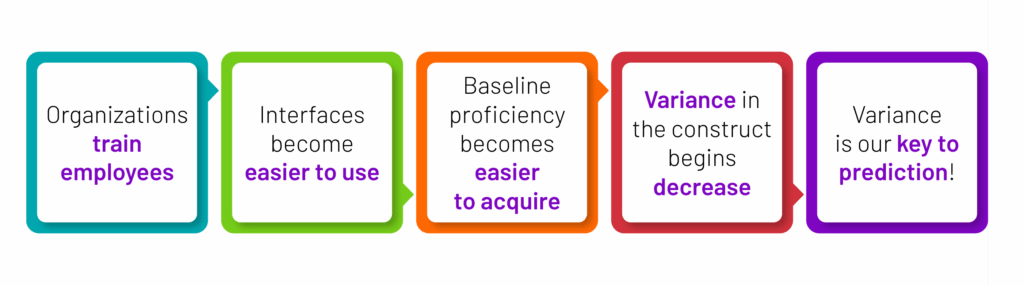
But there is another issue that may matter more. Many technical skills eventually stop differentiating performance. In the early stages of adoption, technical knowledge often matters because some people have exposure and others do not. But over time, organisations upskill employees, systems become easier to use, interfaces become more intuitive, and baseline proficiency becomes easier to acquire. Once everyone reaches a functional level of competence, the predictive value of the skill itself often starts to decline.
Think about the evolution of Microsoft Office skills. There was a time when organisations cared about whether employees were proficient in Word, Excel, or PowerPoint, and this genuinely set candidates apart. If you could build a pivot table, format a document professionally, or create a slide deck, you were considered to have differentiating skills.
But over time as Office became standard in nearly every workplace and taught almost everywhere, the skills stopped being a marker of high performance. These skills became a baseline expectation. Today, knowing how to use these tools doesn’t tell you who is likely to excel in a role. It simply tells you who meets the minimum requirements to function in a modern workplace.
The same thing happens with many tests of technical knowledge, and we suspect AI fluency may evolve similarly. Quite honestly, a reasonably capable new hire can often get up to speed on an organisation’s preferred AI tools in days or weeks. Once everyone has similar access and training, there may not be much meaningful variance left in the construct. And in selection science, constructs without meaningful variance generally stop predicting much of anything.
Why digital dexterity matters more over time
At Talogy, one area we believe provides a more durable and future-oriented foundation is digital dexterity. Digital dexterity is not simply “Can you use this AI tool?” It is more about “How effectively do you adapt as technology changes?”
That relates to capabilities like:
- Learning agility
- Adaptability
- Experimentation
- Comfort navigating ambiguity
- Evaluating outputs critically
- Integrating technology into workflows
Those capabilities remain relevant even as the technologies themselves inevitably change. And that distinction is important because the future workplace will almost certainly not reward mastery of one specific AI interface. The tools will continue evolving too quickly for that.
The more enduring differentiator may be whether someone can continuously learn, adapt, and effectively collaborate with emerging technologies over time. In that sense, digital dexterity may ultimately prove to be a much stronger long-term predictor than narrow AI fluency measures alone.
So, where does AI fluency fit?
Importantly, we are not arguing that AI fluency is irrelevant. Far from it. Organisations absolutely should care whether employees can effectively and responsibly use AI in the workplace. That capability matters and will continue to matter.
We simply view AI fluency as part of a broader capability ecosystem rather than the endpoint itself. AI fluency may be one important signal within a larger set of capabilities that influence effectiveness in AI-enabled work environments. Or said differently: AI fluency may be necessary, but it is probably not sufficient by itself.
The bigger shift: Optimising human-AI collaboration
One example I often use outside of AI: Think about project managers. Most of the technical parts of the job – the software, understanding the workflow, following specific methodologies – are teachable. People can learn to update a project plan, run a status meeting, or use tools such as Teams, Asana, or Jira. But those aren’t the things that separate an average project manager from a great one.
What actually determines who delivers consistently are things like the ability to build trust across teams, navigate conflict, and keep people aligned when priorities shift. Those are the transferable skills that drive outcomes and are much harder to teach.
In other words, the underlying human capabilities end up predicting performance more consistently over time than the narrow technical skill itself. We think there is an important lesson there for AI-enabled work.
This is where we think the conversation ultimately needs to go. Historically, organisations have thought about performance as something people produce independently. But increasingly, workplace performance is emerging from interaction between humans and AI systems. That shifts what we should be paying attention to.
The future question may not simply be “Can the person use AI?” The better question may become “How effectively does the person perform within an AI-enabled system?” Our focus will be on the uniquely human qualities that a person contributes in the system to drive employee performance. That is a much bigger and more dynamic question.
This is the broader idea behind our thinking around human–AI collaboration. The goal is not only to identify who can use today’s AI tools. It is to better understand the human capabilities that will drive effective performance as AI-enabled work systems continue evolving.
The future of AI fluency in the workplace
In the near term, organisations understandably need practical solutions today. AI fluency and AI readiness assessments will likely continue playing an important role as organisations try to better understand workforce capability in this space. But quickly, we expect the market to mature.
The conversation will likely shift away from static measures of AI familiarity and toward:
- Adaptability
- Learning capability
- Human–AI collaboration
- Dynamic performance
- Broader workforce optimisation within AI-enabled systems
- Thinking and behaviour patterns that develop with ongoing AI use and impact results
In other words, the organisations that approach this well will not simply identify who can use AI today. They will answer the more important question: who can continue evolving effectively alongside AI tomorrow?

AI isn’t delivering ROI on its own. People are.
Download this guide to discover why organisations that invest in human capability alongside AI are better positioned to improve productivity, decision quality, innovation, and long-term performance.
WHAT YOU’LL LEARN
- Why AI ROI depends on more than adoption metrics and how organisations often mistake usage for transformation.
- The human factors behind successful AI collaboration, including critical thinking, judgement, learning agility, and decision quality.
- The risks of overlooking workforce readiness, from over-trust and AI misuse to inconsistent performance across teams.
- Talogy’s Human AI Collaboration Model, which helps organisations understand how people interact with AI, how collaboration evolves over time, and how it influences business outcomes.
- How to align talent strategy with AI strategy to maximise productivity, innovation, and organisational performance.