

As you rise in your career, every step up the ladder brings greater exposure to the storm. Early in a career, success is often relatively tangible. There are tasks to complete, problems to solve, and people to learn from. The path is rarely straightforward, but there is often some clarity about what good performance looks like.
Rising into leadership roles changes this. As people take on greater responsibility, the questions you face become increasingly complex. Leaders are responsible not simply for delivering the work, but increasingly for deciding what work matters, managing internal political strife, and acting as the voice of the organization. They must balance competing priorities, make decisions with incomplete information, and consider consequences that extend far beyond themselves.
The pressure, expectations, and impact of decisions all increase. The further someone progresses in their leadership journey, the fewer people there are to support and simply tell them the right answer. In many ways, leadership means learning to navigate increasingly uncertain waters. AI is adding another powerful current, which is keeping people even more off balance and creating another transformational force leaders need to manage.
Leading through the AI storm
Artificial intelligence offers extraordinary opportunities, but those opportunities arrive alongside uncertainty. A leader may simultaneously face pressure to increase efficiency, protect jobs, deliver growth, manage risk, and maintain trust, while making decisions about technologies that are evolving rapidly. Different forces pull in different directions, and the consequences of a decision may not become apparent until much later.
AI alone does not create all these pressures, but it can amplify them. When the storm starts to swirl, leaders need something that prevents them from simply being carried by whichever force is strongest. They need an anchor to hold them steady.
The core beneath how we lead
When we think about leadership, we naturally focus on what leaders do: how they communicate, develop people, and deliver results.These behaviors matter. They are what other people see and experience. However, beneath what we do sits something less visible and arguably more influential: a core that influences how we behave and why we make the choices we make.
We can usually describe what we did in a meeting or explain a decision we made. It can be significantly harder to recognize the attitudes, feelings, and values influencing us along the way. Yet when uncertainty and pressure increase, we may draw more heavily on these less visible parts of ourselves.
That is why understanding your leadership core matters. Two elements are particularly important:
- Emotional intelligence, which shapes how you lead
- Values, which influence why you lead the way you do
Emotional intelligence: Understanding how you lead
Emotional intelligence influences how we express our leadership. It reflects the attitudes and feelings that shape how we understand ourselves and others, interpret situations, and respond under pressure.
Part of this concerns our attitudes. Self-regard reflects how we view and value ourselves. Regard for others reflects our attitudes towards other people. These can influence how confidently we contribute, how receptive we are to others, and how we respond when challenged.
Another part concerns our awareness of feelings. Self-awareness helps us recognize what we are experiencing internally, while awareness of others helps us notice and understand the emotions of those around us.
The emotional lens through which we interpret a situation is largely invisible to others, but its consequences are not. It shapes how we communicate, respond to challenges, and how others experience our leadership. Under pressure, that lens can become even more influential.
A leader who feels challenged might become more controlling. Someone determined to maintain harmony might avoid a necessary confrontation. Caution can become indecision. Becoming more conscious of our emotional intelligence does not remove these reactions. Nevertheless, it gives us a better opportunity to recognize and manage this lens, ensuring how we lead is in line with the way we need to.
In calm waters, it is useful. In a storm, it is essential.
Values: Understanding your why
If emotional intelligence helps us understand how we navigate, values help us understand what matters to us. Values reflect the motivations and priorities that influence what we find meaningful and important. There is no single set of values every effective leader must share. What matters is understanding your own and how they influence your choices.
Values may remain largely beneath the surface. When every option involves compromise, they move to the foreground. The emergence of AI is likely to create more of these moments. AI will also be able to perform many tasks, but it cannot determine what matters most. The higher you rise, the more important having an anchor becomes.
Values often remain beneath the surface until important priorities compete. Growth or stability? Speed or caution? Efficiency or long-term capability? Leadership rarely offers a simple choice between right and wrong. More often, leaders must choose between things that all matter.
AI will create more of these moments. It can tell us more about what is possible, model different outcomes, and recommend a course of action. But it cannot decide what should matter most. That remains a human judgment which will be influenced by your how and why.
Knowing your anchor
As leaders, we spend considerable time focused on our behavior and making things happen. We may spend far less time examining the core from which those behaviors emerge, yet as situations become less predictable and AI makes the world more complicated, that core will become more influential.
Without awareness of ourselves, we can be pulled by emotion without recognizing it. Without awareness of others, we can pursue change without understanding its human consequences. Without clarity about what matters to us, we can be carried towards whichever target is exerting the greatest pressure.
So perhaps one of the most important things leaders can do in the age of AI is not simply acquire new technical skills. They need to become more conscious of the core skills they already carry with them. AI may become increasingly capable of helping leaders determine what they could do with the characteristics they already possess.
But understanding how they lead and why one direction matters more than another remains fundamentally human. The waves will keep coming. The objective is not to avoid them. It is to know what keeps you anchored while you navigate them. An anchor does not stop the storm; it stops the storm from determining where you end up.
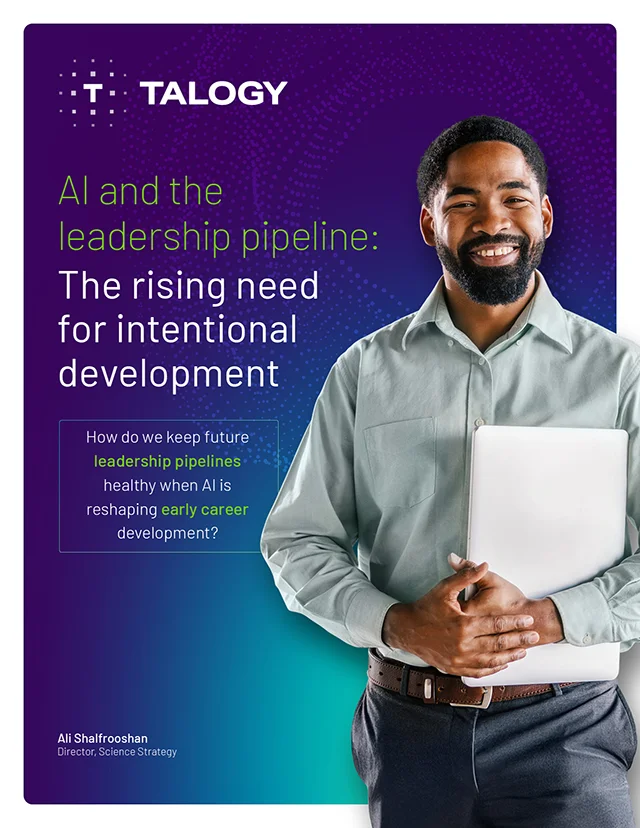
The hidden impact of AI on future leaders
AI is changing how work gets done, and how people develop the skills they’ll need to progress.
As AI takes on more of the tasks that have traditionally helped people build foundational skills early in their careers, valuable on-the-job learning opportunities could be lost. With 78% of HR and talent leaders concerned about the long-term loss of critical leadership skills, organizations need to consider what that could mean as people progress into more senior roles.
Discover how to create more purposeful development opportunities today to strengthen your leadership pipeline for tomorrow in our latest guide, “AI and the leadership pipeline: The rising need for intentional development”.
What you’ll learn:
- How AI is changing early-career development and which valuable learning opportunities could be lost as work evolves.
- Why the impact could reach your leadership pipeline, including the potential implications for skill gaps and promotion readiness.
- Why AI fluency isn’t enough, and why transferable skills remain critical as people take on more complex responsibilities.
- How to make development more intentional by identifying the skills people need at different career stages and creating opportunities to strengthen them throughout the career journey.